Liquid Blood Sugar Drops: Dosage, Timing and How to Take Them
Liquid glucose-support formulas have quietly taken over a shelf that used to be all capsules, and they arrive with a question capsules never raised: how many drops, and when? This is the practical answer — dose, timing, delivery, and an honest account of what the liquid format does and does not buy you.
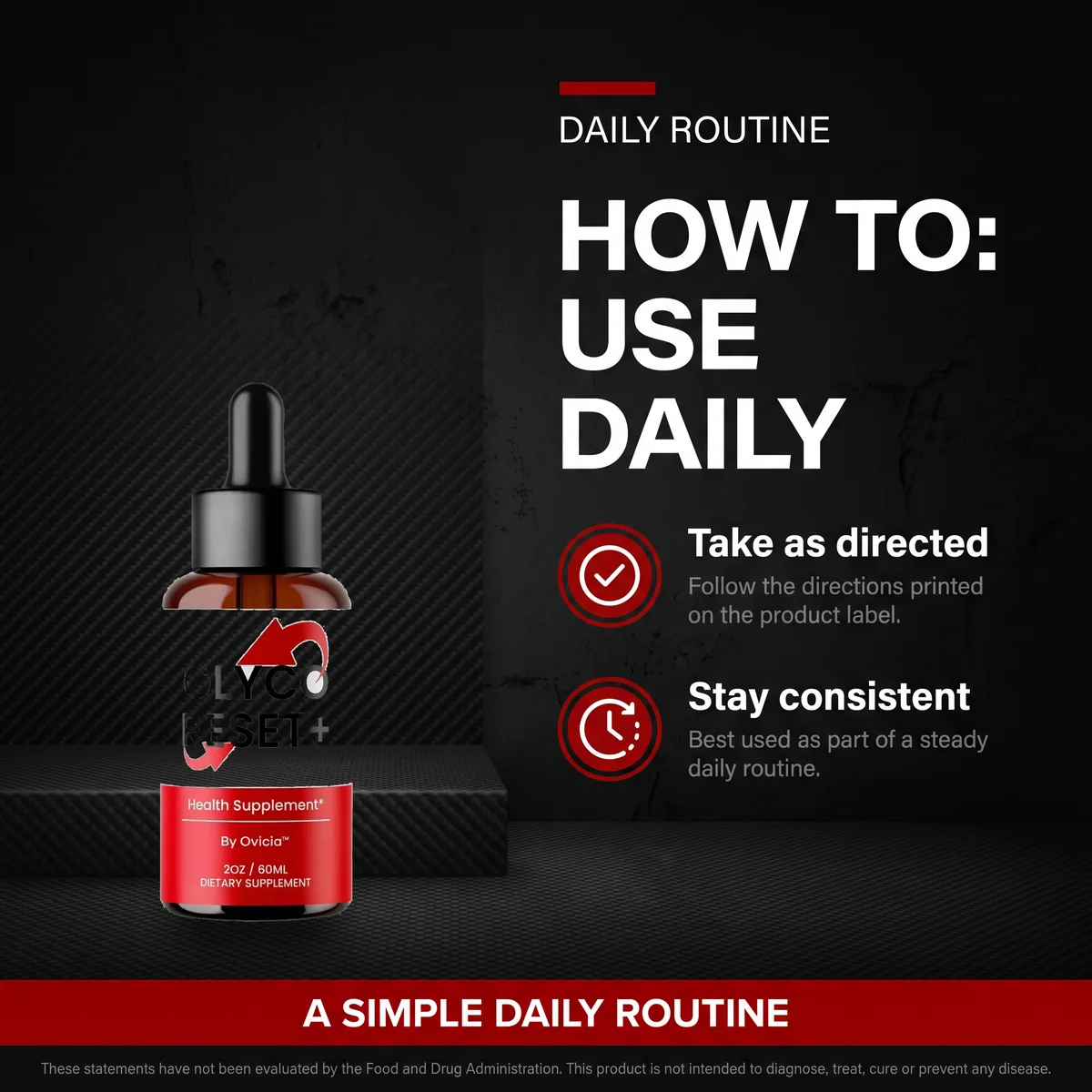
How many drops of a liquid blood sugar supplement do you take per day?
Take the dose printed on your own bottle, which is most commonly one full dropper — usually described as about 1 ml — once or twice daily with food. Concentration varies so widely between products that a dropper of one formula is not equivalent to a dropper of another, so the label is the only figure that means anything. Take it with a meal, keep it consistent, and give it eight to twelve weeks before judging it.
- One full dropper with food is the most common labelled dose.
- Twice-daily labels mean two different meals, not a double dose at one.
- More drops is not a faster result; it is just a bigger dose of an unstudied amount.
What are liquid blood sugar drops?
Liquid blood sugar drops are glucose-support supplements delivered as a flavoured liquid in a dropper bottle rather than as a capsule or tablet. The ingredients are the same family you would find in the pill version of this category: berberine, cinnamon bark, gymnema sylvestre, banaba leaf, bitter melon and the trace mineral chromium, carried in a base of water, glycerin or a similar solvent. A typical bottle holds 2 fl oz (about 60 ml), and a typical labelled dose of roughly 1 ml gives you around a month per bottle.
The format matters for two reasons that have nothing to do with biology. A dropper lets a formulator dose in fractions a capsule cannot, and a liquid suits people who dislike swallowing pills, which is a substantial share of adults. Both are real practical advantages. Neither is a claim about how well the ingredients work.
How do you take blood sugar drops? Directions for use, step by step
The directions below are the general pattern these products follow. Where your label disagrees with anything here, the label wins — it is the only instruction written for the concentration in your bottle.
- Read the label before the first dose. Find the stated dose, how many doses per day, and whether the instruction is to hold the liquid under the tongue or mix it into water. That figure is specific to your bottle's concentration and overrides any general advice, including this article's.
- Anchor the dose to a meal. Take it with food unless the label says otherwise. Food improves tolerance for botanicals such as berberine, and pinning the dose to a meal you already eat is the single most reliable way to actually remember it.
- Fill the dropper to the marked line. Squeeze the bulb and fill the pipette to the line the label describes, not to the top of the glass. A dose you eyeball is a dose that changes daily, which makes the eventual result impossible to read.
- Follow the delivery instruction exactly. Hold the liquid under the tongue for the stated time, or mix it into a small glass of water, as the bottle directs.
- Split the day if the label says twice daily. Put the second dose at a different meal rather than doubling up at one. That matches the pattern used in the ingredient trials, which generally divided the daily amount across meals.
- Stay consistent for eight to twelve weeks. Take it daily, note how you feel, and judge the outcome on weekly averages rather than on any single morning reading.
When is the best time to take blood sugar drops?
With a meal, and at the same meals each day. There are three separate reasons, and they all point the same way.
Tolerance. Berberine is the ingredient most likely to cause digestive upset in this category, and taking it with food is the standard way to reduce that. If a formula is going to give you cramping or loose stools, an empty stomach is where it happens.
Study design. The human trials behind these ingredients did not give a single daily bolus. The best-known berberine trial in Metabolism used a divided regimen taken with meals, and later trials have generally followed that pattern. There is a pharmacological reason for it: berberine is poorly absorbed and cleared fairly quickly, so dividing the day keeps a steadier presence than one large dose would.
Adherence. This is the unglamorous one, and probably the most important. Supplements in this category need months of consistency to be worth judging at all. A dose attached to breakfast survives a busy week; a dose that floats loose in the day does not. If you want more detail on that timeline, our guide to how long blood sugar supplements take to work breaks it into windows.
Under the tongue or in water: does the delivery method matter?
Follow your label, because the honest answer is that nobody has tested this properly for these ingredients. The sublingual instruction — hold the liquid under the tongue for roughly thirty seconds before swallowing — borrows its logic from drugs that genuinely are absorbed through the tissue under the tongue, where the compound bypasses the first pass through the liver. Whether the plant compounds in a glucose-support blend behave that way in any meaningful quantity has not been demonstrated in human trials.
In practice this is modest advice: do what your bottle says, because that instruction goes with the product's own dosing. And if the taste is genuinely unpleasant — berberine is bitter — diluting into a small glass of water is a normal accommodation, not a failure of technique.
Are drops absorbed better than capsules? What the evidence actually says
What the evidence shows. Some compounds do dissolve and absorb more readily when they are already in solution, and formulation science on berberine in particular is an active field precisely because its absorption is so poor; the pharmacokinetic work in Pharmaceutics exists because researchers are trying to solve that problem. So the underlying idea — delivery format can influence how much of a dose reaches the bloodstream — is real.
What it does not show. It does not show that the liquid drops on the shelf outperform capsules of the same ingredients, because no trial has compared them head to head. Every efficacy trial worth citing in this category — the berberine meta-analyses, the cinnamon dose-response reviews, the chromium meta-analysis — used capsules, tablets or powders. When a liquid product borrows those results, it is borrowing evidence generated in a different format at a defined dose. Treat "better absorbed" on a dropper bottle as a marketing claim, and buy the liquid for the reasons that are actually true: it is easier to take, and easier to dose in fractions.
What is actually in liquid blood sugar drops?
The ingredient list is the part worth your attention, far more than the format. Across this category you will repeatedly meet the same short list, and the evidence behind them is not equal:
| Ingredient | Why it is in the bottle | How strong the human evidence is |
|---|---|---|
| Berberine | The lead active in most glucose blends | Strongest of the group; many randomised trials and several meta-analyses |
| Chromium | An essential trace mineral in the normal insulin response | Modest and mixed; clearest where dietary intake was low |
| Cinnamon bark | A long-standing glucose botanical | Plenty of trials, inconsistent results, extract-dependent |
| Gymnema sylvestre | Sweet-taste suppression and sugar cravings | Small trials, limited quality |
| Banaba leaf | Corosolic acid and cellular glucose uptake | Early, small human studies |
| Bitter melon | Traditional use for glucose handling | Small and inconsistent |
Two label habits are worth learning. First, look for named amounts rather than named ingredients: a botanical with no milligram figure beside it tells you nothing about whether it is present at a studied amount. Second, be sceptical of a long proprietary blend, where one total figure covers six or eight ingredients and hides the split between them. We go through the whole list in more depth in our review of the best-evidenced blood sugar supplement ingredients and in our closer look at berberine, cinnamon and chromium as a combination.
The dropper is a delivery choice, not a mechanism. What determines whether a liquid glucose-support formula is worth taking is the same thing that determines it for a capsule: which ingredients are in it, at what amounts, taken consistently for long enough to tell.
Five dosing mistakes worth avoiding
- Scaling the dose up because nothing has happened yet. Three weeks is not a plateau, it is the beginning. Doubling a dropper takes you to an amount nobody has studied in that formula, and with berberine it mostly buys digestive upset.
- Eyeballing the dropper. Filling roughly to the middle one day and near the top the next makes your own experiment unreadable. Use the line.
- Stacking two products with the same actives. A glucose-support liquid plus a standalone berberine capsule plus a multivitamin with chromium is three doses of overlapping ingredients. Add them up before you take them.
- Taking it on an empty stomach because it seems more efficient. It is not, and it is the fastest route to the side effect that makes people quit.
- Adding it on top of glucose-lowering medication without telling anyone. This is the one that can actually harm you, and it is covered properly below.
Who should not take blood sugar drops
The safety points here are not boilerplate; they follow directly from the fact that some of these ingredients have genuine biological activity. If you take insulin, metformin, a sulfonylurea or any other glucose-lowering medicine, do not add a berberine-containing formula without your doctor's involvement, because two agents that lower blood glucose can lower it further than either was meant to. Berberine also influences the enzymes that metabolise many medications, which widens the interaction question beyond glucose alone. Licorice root, which appears in some of these blends, can raise blood pressure and lower potassium with sustained use. Pregnancy, nursing and being under eighteen are reasons to leave the category alone, and anyone managing liver or kidney conditions should ask first. The NIH National Center for Complementary and Integrative Health is a good neutral starting point, and the FDA's dietary supplement guidance explains why a supplement label is not a treatment claim.
What a realistic result looks like
Set the expectation before you start, because it is what stops the dose creeping up. A glucose-support liquid is a supporting layer on top of the things that actually move blood sugar: what you eat, how much you move, how you sleep and what you weigh. If it does anything for you, it will be gradual, and it will be far easier to see if the rest of your routine holds still while you test it.
The fundamentals are worth getting right first, and several of them are free: a short walk after meals, and eating the same meal in a different order, both have more direct evidence behind them than anything in a dropper bottle. A supplement is a reasonable addition to that. It is not a replacement for it, and it is not a treatment for any diagnosed condition — a distinction we set out at length in our piece on the blood sugar supplement myths worth knowing.
Frequently asked questions
How many drops of a blood sugar supplement should you take per day?
Follow the dose printed on your bottle, because it is the only figure that matches what is actually in that liquid. Most glucose-support droppers are labelled at one full dropper (commonly described as about 1 ml) once or twice daily with food, but concentration varies enormously between products, so a dropper of one formula is not equivalent to a dropper of another. Never scale the dose up because progress feels slow.
When is the best time to take liquid blood sugar drops?
With a meal is the usual instruction, and it is a sensible one. Botanicals such as berberine are generally better tolerated with food, the trials behind them split the daily amount across meals, and anchoring the dose to breakfast or dinner is the single most reliable way to remember it. If the label says twice daily, spacing the doses across two separate meals matches the studied pattern most closely.
Do you hold blood sugar drops under the tongue or mix them in water?
Do whatever your label says. Some liquid formulas direct you to hold the dose under the tongue for around thirty seconds, others say to add it to water or juice. Neither instruction has head-to-head human evidence behind it for these particular botanicals, so the label is the instruction to follow rather than an internet rule. If the taste is difficult, mixing into a small amount of water is a reasonable and common approach.
Are liquid drops absorbed better than capsules?
There is no good human evidence that liquid glucose-support drops are absorbed better than capsules of the same ingredients. It is a plausible idea for compounds that dissolve readily, and it is the reason liquids are marketed the way they are, but no trial has compared a liquid and a capsule form of these botanicals head to head. The honest position is that liquids are easier to swallow and easier to dose in small increments, and that absorption superiority is a marketing claim rather than a finding.
Can you take blood sugar drops with diabetes medication?
Not without your doctor's involvement. Several ingredients common in these formulas, berberine most of all, can lower blood glucose on their own, so adding them on top of insulin or another glucose-lowering medicine can stack the effects and push blood sugar too low. Berberine can also affect how the body processes other drugs. Ask your doctor or pharmacist first, and monitor if they agree to it.
References
- Efficacy of berberine in patients with type 2 diabetes mellitus. Metabolism, 2008 (PMID 18442638)
- Characterization and pharmacokinetic assessment of a berberine formulation with enhanced absorption in human volunteers. Pharmaceutics, 2023 (PMID 38004546)
- Berberine in the treatment of type 2 diabetes mellitus: a systematic review and meta-analysis. Evid Based Complement Alternat Med, 2012 (PMID 23118793)
- The effect of cinnamon supplementation on glycemic control in type 2 diabetes: an updated dose-response meta-analysis. Phytother Res, 2024 (PMID 37818728)
- Systematic review and meta-analysis of the efficacy and safety of chromium supplementation in diabetes. J Clin Pharm Ther, 2014 (PMID 24635480)
- NIH NCCIH — Diabetes and Dietary Supplements
- U.S. FDA — Dietary Supplements
Related reading
See the dosing directions on the Glyco Reset label
The full ingredient list, the current sale pricing and the 60-day money-back guarantee on the official store.
Order Now